

by John Wijngaards
Literary sources have left us ample records of deaconesses in different parts of the Byzantine Empire. Constantinople’s main cathedral, the Hagia Sophia, counted among its clergy 60 priests, 100 male deacons and 40 deaconesses (Justinian, Novella 3.1).
For a full list of deacons from the early church see records.
Here are some deaconesses we know by name, often because of their connections with Church leaders. They represent thousands whose names remain hidden, like those of the ordinary priests and deacons.
Olympias in Constantinople, ordained by Bishop Nektarios, friend of St. Gregory of Nazianze and later of St. John Chrysostom whom she greatly helped during his conflict with the Emperor and exile. Died in 418 AD.
‘Anonyma’ about whom we know that she ministered in Antioch during the persecution of Julian the Apostate (361-363 AD).
Pentadia, a deaconesses to whom St. Chrysostom wrote letters.
Salvina whom St. Jerome knew and who later became a deaconess in Constantinople.
The deaconess Anastasia whom Severus, Bishop of Antioch, mentions in his letters.
The deaconess Macrina, sister of St. Basil the Great, and her friend and deaconess Lampadia.
The deaconess Theosebia, wife of St. Gregory of Nissa.
The names of some deaconesses have also been preserved on tomb stones. At least 28 have been identified. Here are some typical examples:
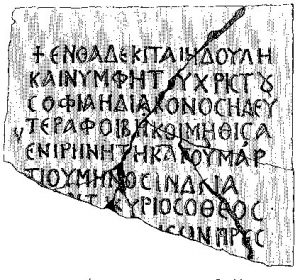
* Sophia of Jerusalem (4th cent. AD?). The Greek inscription reads: “Here lies the servant and virgin of Christ, the deacon [!], the second Phoebe [Rom 16,1], who passed away in peace on the 21st day of March . . . May the Lord God . . .” (R. P. L. Cré, “Epitaphe de la diaconesse Sophie”, Revue biblique, vol. 1, no. 2 (1904), pp. 260-262 at 262).
* Theodora of Gaul (present-day France) carried this Latin inscription on her tomb: “Here rests in peace and of good remembrance Theodora the deaconess who lived about 48 years and died on 22 July 539.”
* Another tombstone found in Delphi, Greece, and belonging to the 5th century remembers a certain Athanasia. “The most devout deaconess Athanasia, established deaconess by his holiness bishop Pantamianos after she had lived a blameless life. He erected this tomb on the place where her honoured [body ?] lies. If someone else dares to open this tomb in which the deaconess has been buried, may he receive the fate of Judas, who betrayed our Lord Jesus Christ … Nothing less the clerics who were found gathered … ” (H. Leclercq, Dictionnaire de’Archéologie Chrétienne, Paris 1921, vol. IV, col. 570-571).
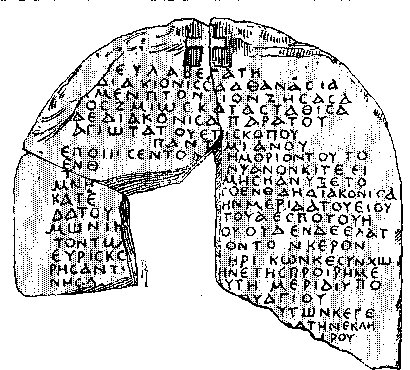

* Another tombstone at Jerusalem remembers the deaconess Eneon who ministered to the sick: “Tomb of Eneon, daughter of Neoiketis, deaconess in this hospital” (Kevin Madigan and Carolyn Osiek. Ordained Women in the Early Church: A Documentary History. Baltimore: John Hopkins University Press, 2005, pp. 79-80, referring to Joseph Germer-Durand, “Épigraphie Chrétienne de Jérusalem”, Revue Biblique 1, no. 4 (1892): 560–88, at 566).
More detailed information can be found from these authors:
Kristin Arnt, Die Diakonissen der armenischen Kirche in kanonischer Sicht, Vienna 1990.
Eva Maria Synek, Heilige Frauen der frühen Christenheit, Würzburg 1994.
Ute Eisen, Ämtsträgerinnen im frühen Christentum, Göttingen 1996.
Kevin Madigan and Carolyn Osiek. Ordained Women in the Early Church: A Documentary History. Baltimore: John Hopkins University Press, 2005.