The ancient sacramentaries of Roman Empire times
from (100 ?) 313 - 600 AD
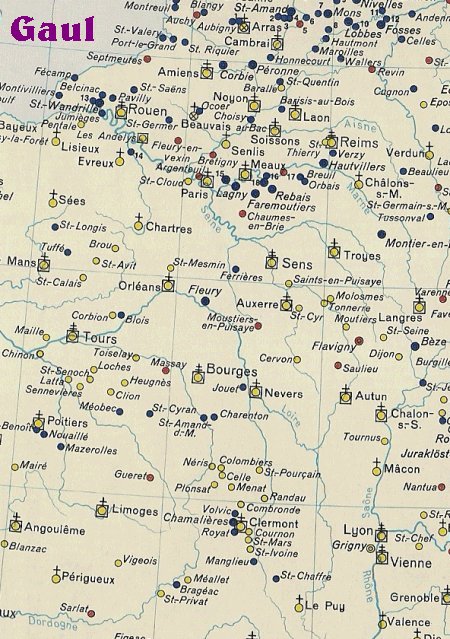
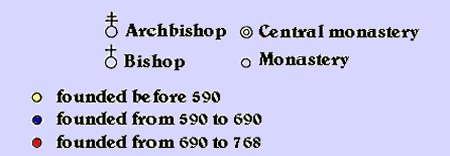
The ordination of women deacons as it must have been in the - now lost - sacramentaries used by early bishops during the years of the Roman Empire. We infer the original text of the ordination rite from evidence found in later sacramentaries and pontificals.During the Roman Empire, and especially since the Edict of Milan (313 AD) which gave Christians freedom to worship, women were ordained as deacons. The ministry of women in Britain, for instance, is documented in the so-called Walesby Tank (5th cent.) and among 'British' immigrants who came to Gaul (Letter 511 AD). The strongest evidence comes from Gaul (present-day France). As can be seen from the map, many dioceses were founded before 590 (yellow circles) and many more from 590 to 690 (blue circles). Because of Roman prejudice against women's leadership, and perhaps fear of menstruation, there was fierce opposition to women ministering as deacons. But the multiple demands to stop ordaining women as deacons prove it was still done. For a list of these Synods, their full texts and an assessment, click here. |
  |
Gallic opposition against the ordination of women is confirmed by the Leonine Sacramentary (600 AD) a loose collection of prayers judged useful by its Gallic scribe. It does contain the ordination rite for male deacons, but omits the ordination rite for women deacons.
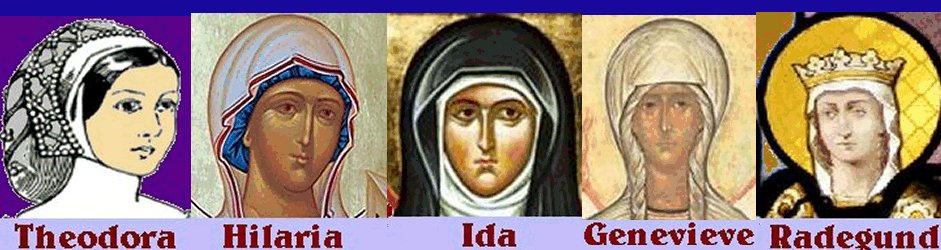
Tradition has left us the names of women who served as deacons. In Rome they were Tryphena (1st cent.), Tatiana (3rd cent.) and Melania the Younger (383-439). In Padua we find St. Justina who died as a martyr in 340 AD. St Geneviève of Paris (419-502) and St Radegunde (520–586) lived in Gaul. More information found here.
 |
German lands too were evangelised with the coming of Christian Roman soldiers. On the map, notice the dioceses (marked yellow or blue) that date from before 690 AD. Indeed, there have been bishops from the earliest times. For instance, we know the names of at least 40 bishops who presided over the diocese of Mainz from 80 to 745 AD. These bishops used sacramentaries for their liturgy. What did they contain about women deacons? Nine Germanic pontificals based on an ancient Romano-Germanic sacramentary provide the clue. From evidence preserved by them we can deduce that, in parallel to the ordination of male deacons, they offered an ordination rite for women deacons that held: 1. a title
|
The rite of a woman deacon's ordination
as can be inferred from evidence in nine Pontificals
|
Sacramentaries at this time contained more prayers under each heading, e.g. under 'to make a priest', 'to make a deacon', because these were the chief prayers which were said by the celebrant, the bishop, during the ordination. Rubrics - saying what needed to be done, such as the laying on of hands - were not written in the early sacramentaries. The liturgical master of ceremony would tell the bishop what to do. Readings of Scripture were contained in a separate lectionary. The appropriate antiphons, chants and psalms were seen to by the choirmaster. So when we read a sequence of prayers belonging to an ordination within a sacramentary, they are not recorded at random. People at the time knew where they needed to be put within the context of the ordination mass. |
In a sacramentary the prayers are like peaches that have not yet been 'canned' [= put into tins].
|
|---|---|
|
In Pontificals, the original sequence of ordination prayers is 'dressed up' within a fully outlined Mass, now including also rubrics, references to chaunts and psalms, readings, blessings, etc. So from a fully-fledged ordination Mass we can extract the ordination prayers and from them extrapolate [= infer] what sequence of ordination prayers were contained in the sacramentary it used. |
The Pontifical 'cans' them. From the can, even if half empty, we can deduce the contents. |

Our sources for this extrapolation of the rite of ordaining women deacons are nine manuscripts of pontificals (click on each for its detailed text):
The Text





Ordination of a woman deaconas reconstructed from the 9 Pontificals listed above |
Ordination of a male deaconby way of comparison |
|||
|
Title |
To make a
(male) deacon |
||
|
Invitation prayer The prayer for men is in the pontificals as printed here. For women this prayer has been reconstructed from the unique blessings on women deacons at the end of her ordination Mass (see no 25 here). |
Prayer Beloved, let us pray that God the Almighty Father may mercifully pour the grace of his blessing [= ordination] over this (these) servant(s) of His; and grant him (them) the gift of consecration by which He may lead him (them) to eternal rewards, with the help of our Lord Jesus Christ, who lives and reigns with you as God. Through. |
||
|
Ordination prayer identical for men & women preserved in the Sacramentaries and Pontificals |
|
|
Consecration also known as second ordination prayer |
Consecration | ||
|---|---|---|---|---|
|
The justification for ordaining women as deacons. Just as for male deacons the main model is the Levites who served in the Temple, for female deacons the main model is Anna who also served in the Temple. Women deacons are (a) to be prophetic [= instruct in the faith] and (b) anoint women with chrism. They fulfilled both functions at the baptism of women catechumens.
|
(i) Be present we ask you, o Lord, you
giver of all good things, distributor of ranks and assigner of tasks, who while
remaining true to yourself renews everything and through your word, power and
wisdom arranging everything, prepares in your eternal providence Jesus Christ,
your Son, our Lord, and who fixes everything for each unique moment in time;
you, who grant that his (Christ's) body, your Church, grows and extends
distinct in a variety of celestial gifts and a difference of its (the Church's)
members by a marvelous law a unity of coherence into an increase of your
temple, stipulating that a service of the sacred task through three degrees of
ministers serve your name; having chosen from the beginning the sons of Levi to
stay in the inner rooms of your house attending to their mystical tasks, so
that they might possess the inheritance of eternal blessing through a perpetual
fate, |
||
|
This must have been part of the original consecration prayer, here reconstructed from the male ordination. It is missing in the Pontificals. |
|
||
|
Calling on God to make up for deficiencies in the candidate The texts are found in the Pontificals. |
(iii) We who are, indeed, as human beings
not aware of divine perception and supreme reason, we assess, to the extent we
can, his (their) life. But things unknown to us do not escap you, o Lord. You
do not miss what is hidden. You scrutinise secrets of the hearts. You can
examine his (their) life with you heavenly judgment through which you are
always able to purge what is missing and allow what needs to be done.
|
||
|
Also this crucial part of the consecration preface for women deacons is now missing in the Pontificals. We reconstruct it here from the male parallel. |
|
||
|
The concluding prayer for help still contains references to her ministry among women. |
(v) May the form of every virtue abound in him (them): restrained authority, constant modesty, the purity of innocence and the observance of spiritual discipline. May your precepts shine in (his) their morals, and may the people through their example of chastity obtain holy imitation. And may he (they) carrying the good testimony of conscience, persevere firm and unshakable in Christ, and may he (they) deserve in worthy steps to proceed from the inferior rank through your grace to higher things (ranks). Through our Lord. |
The sources once again (click on each for details)

Video Presentations
Ordained women deacons
Tens of thousands of ordained women deacons served in parishes during the first millennium of the Church.

Ministries in the West
Women exercised a variety of ministries in North Africa and in different regions of Western Europe.

The Tasks of Women Deacons
Women deacons fulfilled pastoral functions at baptism, communion and anointing of the sick.