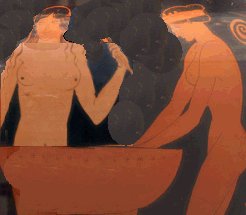
A Woman Deacon's Apostolate
	 The deaconess shared with the deacon the care of the sick and needy in
		the parish.

		 “Let the deacons be in all things unspotted, as the bishop
		  himself is to be, only more active; in number according to the largeness of the
		  Church, that they may minister to the infirm as workmen that are not
		  ashamed. And let the deaconess be diligent in taking care of the women; but
		  both of them ready to carry messages, to travel about, to minister, and to
		  serve, as spake Isaiah concerning the Lord, saying: "To justify the righteous,
		  who serves many faithfully." Let every one therefore know his proper place,
		  and discharge it diligently with one consent, with one mind, as knowing the
		  reward of their ministration; but let them not be ashamed to minister to those
		  that are in want, as even our" Lord Jesus Christ came not to be ministered
		  unto, but to minister and to give His life a ransom for many."
		  Apostolic Constitutions 3, no
		  19.

	 One special responsibility of the deaconess was looking after the
		‘widows’, which in this period referred to a class of elderly women
		who received financial support from the community and who performed duties for
		the Church.

		“The widows therefore ought to be grave, obedient to their
		  bishops, and their presbyters, and their deacons, and besides these to the
		  deaconesses, with piety, reverence, and fear; not usurping authority, nor
		  desiring to do anything beyond the constitution without the consent of the
		  deacon: as, suppose, the going to any one to eat or drink with him, or to
		  receive anything from anybody. But if without direction she does any one of
		  these things, let her be punished with fasting, or else let her be separated on
		  account of her rashness.” Apostolic Constitutions 3, no
		  7


		III, no 14. But those widows which will not live according to
		  the command of God, are solicitous and inquisitive what deaconess it is that
		  gives the charity, and what widows receive it. And when she has learned those
		  things, she murmurs at the deaconess who distributed the charity, saying, Dost
		  not thou see that I am in more distress, and want of thy charity? Why,
		  therefore, hast thou preferred her before me? She says these things foolishly,
		  not understanding that this does not depend on the will of man, but the
		  appointment of God. For if she is herself a witness that she was nearer, and,
		  upon inquiry, was in greater want, and more naked than the other, she ought to
		  understand who it is that made this constitution, and to hold her peace, and
		  not to murmur at the deaconess who distributed the charity, but to enter into
		  her own house, and to cast herself prostrate on her face to make supplication
		  to God that her sin may be forgiven her. For God commanded the deaconess who
		  brought the charity not to proclaim the same, and this widow murmured because
		  she did not publish her name, that so she might know it, and run to receive.
		  Apostolic Constitutions 3,14
	 The deaconess also had a special task in evangelizing men and women in
		their homes.

		This had been one of the original reasons for women's involvement in
		  the apostolate, as we read in Clement of Alexandria: “ For the apostles,
		  giving themselves without respite to the work of evangelism as befitted their
		  ministry, took with them women, not as wives but as sisters, to share in their
		  ministry to women living at home: by their agency the teaching of the Lord
		  reached the women’s quarters without arousing suspicion”.
		  Stromata Book 3, chap. 6, 53.


		An example of this apostolate is given by Theodoret of Cyrus (466 AD)
		  who tells the story of a deaconess in Antioch who instructed and converted the
		  son of a pagan priest in the Christian faith. Out of propriety, or perhaps for
		  safety reasons, she is known as ‘Anonyma’. This was the period of the
		  persecutions under Emperor Julian (361-363 AD). After fully preparing the young
		  man for baptism, she helped him escape from his father's house so that he could
		  join the Christian communityn in a safer locality. (Details in Anne Jensen,
		  Gottes selbstbewusste Töchter: Frauenemanzipazion im frühen
		  Christentum, Freiburg 1992, pp. 49-50.

Video Presentations
Ordained women deacons
Tens of thousands of ordained women deacons served in parishes during the first millennium of the Church.

Ministries in the West
Women exercised a variety of ministries in North Africa and in different regions of Western Europe.

The Tasks of Women Deacons
Women deacons fulfilled pastoral functions at baptism, communion and anointing of the sick.